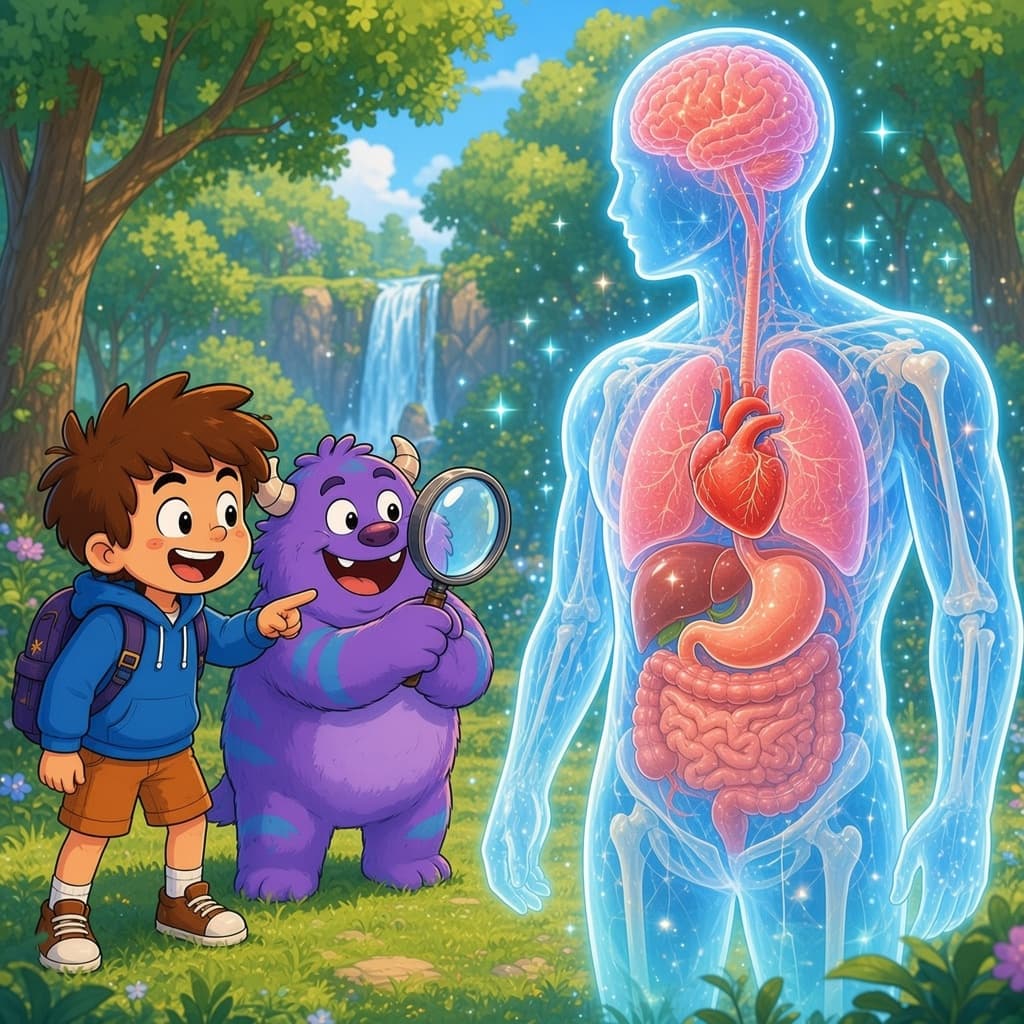
Human Body AdventureGrades 1–6 Science for Kids

Explore your heart, lungs, brain, teeth, skin and more!

Human Body Adventure is an interactive human body lesson for kids in grades 1 to 6. Kids explore the heart, lungs, brain and senses, digestion, teeth, bones and muscles, and skin with a friendly monster guide. Each body part has a read-aloud lesson, key words, healthy habits, a hands-on experiment and a quiz.

  • Grades 1–6
  • 7 lessons
  • 7 experiments
  • 28 practice questions
  • About 75 min
Human Body Adventure: a boy and the purple monster exploring the human body

Human Body Adventure · Learning goals

What Your Child Will Learn

Go on an adventure inside your body! Discover how your heart, lungs, brain, tummy, teeth, bones, muscles and skin all work together as a team, and learn healthy habits to take care of them.

  • Heart
  • Lungs
  • Brain & Senses
  • Digestion
  • Teeth
  • Bones & Muscles
  • Skin

Why it matters

Why This Matters for Kids

  • Knowing your own body

    Understanding how the heart, lungs and brain work helps kids make sense of how they feel, grow and stay well.

  • Healthy habits for life

    Every lesson links science to daily habits like brushing teeth, eating well, sleeping and staying active.

  • Body systems work together

    Kids see how organs connect, like lungs giving oxygen to blood that the heart pumps, the base of biology in later grades.

Inside Human Body Adventure

How the Course Works

Each level has a short read-aloud lesson, an interactive experiment and a mini quiz.

  1. Step 1 · Lesson

    Heart

    Your heart is a strong muscle. It is about the size of your fist. It works hard every second of every day to keep you alive, and it never takes a break!

  2. Step 2 · Lesson

    Lungs

    Your lungs help you breathe. You have two lungs, one on each side of your chest. They are soft and spongy, a bit like two big balloons.

  3. Step 3 · Lesson

    Brain & Senses

    Your brain is the boss of your body. It helps you think, learn, remember, feel and move. Everything you do starts with a message from your brain!

  4. Step 4 · Lesson

    Digestion

    Digestion is how your body breaks down food. It turns food into energy to help you grow, think and play.

  5. Step 5 · Lesson

    Teeth

    Your teeth are small, hard and white. They are the hardest part of your whole body! They help you bite, chew and even talk.

  6. Step 6 · Lesson

    Bones & Muscles

    Bones are the hard frame inside your body. Muscles are soft and stretchy, and they help you move. Together they let you run, jump, climb and dance!

  7. Step 7 · Lesson

    Skin

    Your skin covers your whole body, like a stretchy coat. It is the biggest part of your body! Your hair and nails grow from your skin too.

  8. Step 8 · Final challenge

    Final Challenge

    A big quiz mixing questions from every body part.

Lesson preview

A Peek Inside the Lesson

This is the real lesson text your child hears, read aloud by a friendly voice.

Heart

Your heart is a strong muscle. It is about the size of your fist. It works hard every second of every day to keep you alive, and it never takes a break!

Your heart pumps blood all around your body. The blood travels through tiny tubes called blood vessels. It carries oxygen and food to every part of you, from your head to your toes.

Lungs

Your lungs help you breathe. You have two lungs, one on each side of your chest. They are soft and spongy, a bit like two big balloons.

When you breathe in, air goes in through your nose or mouth and fills your lungs. Your lungs take oxygen from the air and put it into your blood. When you breathe out, they push out air your body does not need.

Brain & Senses

Your brain is the boss of your body. It helps you think, learn, remember, feel and move. Everything you do starts with a message from your brain!

Your brain gets messages from your five senses. You see with your eyes, hear with your ears, smell with your nose, taste with your tongue and touch with your skin. Then your brain tells your body what to do.

Digestion

Digestion is how your body breaks down food. It turns food into energy to help you grow, think and play.

Your teeth chew food into small pieces, and your spit makes it soft. Your stomach squishes it into mush. Your intestines take the good parts, called nutrients, into your blood. The rest leaves your body when you go to the toilet.

Teeth

Your teeth are small, hard and white. They are the hardest part of your whole body! They help you bite, chew and even talk.

Your front teeth are sharp, to bite into an apple. Your back teeth are flat and wide, to chew and grind your food. Your teeth also help you make sounds when you talk.

Bones & Muscles

Bones are the hard frame inside your body. Muscles are soft and stretchy, and they help you move. Together they let you run, jump, climb and dance!

Bones hold you up and keep your insides safe. Your skull protects your brain, and your ribs protect your heart and lungs. Muscles pull on your bones to make you walk, jump and wave.

Skin

Your skin covers your whole body, like a stretchy coat. It is the biggest part of your body! Your hair and nails grow from your skin too.

Your skin keeps germs and dirt out of your body. It helps you feel touch: hot, cold, soft, rough and sharp. When you get hot, your skin makes sweat to cool you down.

For parents

Try It at Home

Learning sticks best when kids use it in real life. Here are simple ideas from this course.

Parent Tip

Have your child feel their pulse at the wrist, then do 20 jumping jacks and feel it again. Talk about why the heart beats faster when we move.

Rest vs Run

  1. Sit still. Put your hand on your chest and feel your heart beat.
  2. Now run in place for 30 seconds!
  3. Put your hand on your chest again. Is your heart beating faster or slower?

When you run, your heart beats faster to send more blood and oxygen to your muscles.

The Big Breath

  1. Take a small breath, then blow out slowly: ssss. How long does it last?
  2. Now take a big, deep breath and blow out slowly again.
  3. Which breath lasted longer?

Your lungs fill with air like balloons. A big breath puts more air in your lungs, so you can blow out for longer.

Catch the Star

  1. Watch the box and wait.
  2. When the star pops up, tap it as fast as you can!
  3. Play 5 rounds and see your fastest time.

Your eyes send a message to your brain, and your brain tells your finger to move. It all happens in less than a second!

The Chew Test

  1. Chew one cracker into tiny pieces. Keep the other cracker whole.
  2. Drop both crackers into stomach juice.
  3. Which one breaks down first?

Chewing breaks food into small pieces, so stomach juices can break it down faster.

Plaque Busters

  1. Get your toothbrush and a tiny bit of toothpaste.
  2. Brush each part of your mouth for 30 seconds.
  3. Brush for 2 minutes in all, then check your teeth in a mirror.

Brushing for 2 minutes, twice a day, sweeps away sticky plaque so it can't hurt your teeth.

Muscle Partners

  1. Hold the front of your upper arm with your other hand.
  2. Bend your arm slowly. What does the muscle feel like?
  3. Now hold the back of your arm and straighten it.

Muscles can only pull, so they work in pairs: one pulls to bend your arm and the other pulls to straighten it.

The Touch Map

  1. Ask a grown-up to hold two pencil tips close together.
  2. Close your eyes. The grown-up touches your skin with one or two tips.
  3. Say how many you feel on your fingertip, hand and arm.

Your skin has tiny touch sensors. Fingertips have the most, so they can feel tiny details best.

Practice

Grades 1–6 Science Practice Questions

Real questions from Human Body Adventure. Try them with your child, then tap to see the answer.

  1. Question 1

    What does your heart pump?

    • A.Air
    • B.Blood
    • C.Food
    Show answer

    Blood

  2. Question 2

    How many lungs do you have?

    • A.One
    • B.Two
    • C.Four
    Show answer

    Two

  3. Question 3

    Which part of your body is the boss?

    • A.Your brain
    • B.Your knee
    • C.Your hair
    Show answer

    Your brain

The full course has 28 questions with instant feedback, stars and rewards. Create a free account to play them all.

Human Body Adventure · Questions from parents

Frequently Asked Questions

What age is this course for?

Human Body Adventure is made for grades 1–6 (ages 6–12). The lessons are short and friendly enough for younger kids, and each grade gets questions that match its level.

What will my child learn?

Go on an adventure inside your body! Discover how your heart, lungs, brain, tummy, teeth, bones, muscles and skin all work together as a team, and learn healthy habits to take care of them. Along the way they practice: Heart; Lungs; Brain & Senses; Digestion; Teeth; Bones & Muscles.

How long does the course take?

About 75 minutes in total, split into 8 short levels. Most kids finish it over two or three sessions. Progress is saved, so they can stop any time and pick up where they left off.

Is this course free?

Yes. Human Body Adventure is one of the first 2 courses in Grades 1–6 Science. Create a free parent account and your child can start right away.

Does my child need to read well to use it?

No. Every lesson has a friendly read-aloud voice, questions are read aloud too, and the pictures help kids follow along. Confident readers can turn the voice off.

Can we use it for homeschool?

Yes. SkillBloom is built for homeschooling families. Kids work through lessons, games and quizzes on their own, and the parent dashboard shows what they finished and which skills need more practice. It works on phones, tablets and laptops.

Keep learning

More Grade 1 Science Courses

More Grade 1 Subjects

A boy and his monster friend watching the sunset near a castle

Ready for the Adventure?

Join our first families and start learning with SkillBloom.

Get Started Now